I am JaKePositive...I am a Homosexual...I am a Filipino...I am a Proud Ilonggo... I am HIV + since June 2010... I started my ARV Treatment May 4,2013 since my CD4 dropped to 107... I am here to RAISE AWARENESS... I am here to ENCOURAGE HIV TESTING... I am here to SUPPORT MY BROTHER'S and SISTER'S who are living with HIV... I am an ADVOCATE FOR CHANGE...

Sunday, September 16, 2012

WORLD VISION: CHANNELS OF HOPE EMPOWERMENT WORKSHOP/SEMINAR


http://www.globalcoal-phil.org/images/masthead_right_001.gifWorld Vision is a Christian relief, development and advocacy organization dedicated to working with children, families and communities to overcome poverty and injustice. Motivated by our Christian faith, World Vision is dedicated to working with the world’s most vulnerable people. World Vision serves all people regardless of religion, race, ethnicity or gender.
World Vision partners with children and the communities among the poorest areas to help improve lives and combat poverty.

World Vision strives to build thriving communities where peace and justice prevail and all can enjoy security, opportunity and happiness. We work for the well-being of the poor and vulnerable people through:  

  • Sustainable development. World Vision works alongside the disadvantaged communities enabling them to use their own capacities and potentials so that they can own the development process.  

  • Emergency Response and Disaster Relief. World Vision responds to life-threatening situations where its involvement is needed and appropriate. I seeks to protect vulnerable people amid difficult circumstances by providing emergency relief such as food, water, shelter, medicine, clothing, and disaster preparedness trainings.  

  • Raising Public Awareness and Advocating for Justice. By increasing understanding of poverty and injustice, World Vision seeks to promote public involvement and government policies that alleviate poverty.
 

Getting to zero together!

As we observe World Aids Day this year, we stand together as a nation with the rest of the world to demonstrate solidarity against the deadly disease. Only by working hand in hand will we be able to get to zero together. Zero New HIV Infections. Zero Stigma & Discrimination. Zero AIDS Related Deaths. 
The World Health Organization (WHO) declares that in 2009 over 34 million people worldwide live with HIV and over 15 million children are affected by their parents’ death caused by AIDS. Over 2 million children live with HIV/AIDS.
Though the number of new HIV infections has declined worldwide, the number of those infected in the Philippines has increased.  In 2011 alone approximately 1,800 confirmed new HIV infections were declared in just the first 10 months of the year. The numbers reveal a stark contrast to the annual reported cases of the whole 2009 which totals 835. Majority of those infected are male aged 20 to 29 with the Department of Health stating that an average of 6 infections is reported every day.
As the infected are faced with this deadly disease they not only encounter the physical damage but heavy on their hearts is the emotional suffering caused by stigma and discrimination.  
World Vision in partnership with Channels of Hope has developed workshops to stop the stigma and discrimination to give love to those who need it most. Related to the theme of World AIDS day for 2011-zero discrimination, World Vision and the Channels of Hope Team currently conduct interactive workshops intended to create awareness and help bring hope to those infected. Participants learn more information about HIV & AIDS, its prevention and combating stigma & discrimination related to the illness.
A participant shares, “This workshop challenged my views in terms of how people living with HIV & AIDS can have hope through the available treatment and from their other support group, that the discrimination and stigma must be less or none, that a person living with HIV should not be judged and how can I help them as a Christian!”

HIV and AIDS in the Philippines are described as ‘hidden and growing’. With the increasing numbers of Filipinos going in and out of the country, cases of human trafficking, sex trades, lack of information, lack of health services, and inadequate response of government agencies on the issue, Filipinos are in danger of being infected of the HIV and AIDS epidemic through sexual and non-sexual (e.g.,blood transfusion and mother-to-child). The 2009 Integrated HIV Behavioral and Serological Surveillance (IHBSS) report showed Fillipinos afflicted with HIV and AIDS is steadily growing. The report shows that since 2001, number of new cases in the Philippines has increased by 334%. 

The Channels of Hope (COH) is World Vision’s response and initiative to address the issues on HIV and AIDS.  COH brings hope to all people whose lives have been impacted and affected by HIV and AIDS. COH equips people with correct information about HIV and AIDS, assists individuals to be more compassionate in dealing with people living with HIV, and engages with local churches and faith communities to respond positively.

World Vision's "Prevention , Care and Advocacy" HIV/AIDS response stratety focuses on building the capacity of communities to a) prevent the spread of HIV b) care and advocate for people living with HIV/AIDS and orphans and vulnerable children.

Christo Greyling
A hemophiliac, Greyling tested positive for HIV while attending theological seminary in 1987. He publicly disclosed his HIV status in 1992, while serving as a minister in the Dutch Reformed Church in South Africa.

Christo Greyling is World Vision’s Director for HIV and Infectious Diseases. His vision is to see World Vision contribute towards reaching ZERO new HIV infections in children by the end of 2015. As an HIV positive faith leader, he realised the potential of faith communities and co-developed the Channels of Hope methodology to equip local faith leaders and congregations to respond effectively to HIV and AIDS. He served as board member of HIV focused NGOs such as INERELA+, CABSA and EAA.


PERSONAL TESTIMONIAL:

WORLD VISION: CHANNELS OF HOPE provided an EMPOWERMENT WORKSHOP/SEMINAR for People Living with HIV in Western Visayas last  SEPTEMBER 12,13,14 & 15 , 2012 @ CENTENNIAL RESORT HOTEL AND CONVENTION CENTER,l ALTA TIERRA VILLAGE, JARO, ILOILO CITY. There were around 40 participants who attended the said Workshop and I was one of them. It provided us an environment conducive to empower ourselves and at the same time be able to connect with our creator and thanking him for making us a more stronger person and also it nurtured our faith with our creator. 
It inspired me to see people who are very much devoted to facilitate the said event. I have never seen a Christian Organization who welcomed us and provided us wisdom and inspired us to move on with life and to Trust GOD with his plan for us.

To all the Facilitators Ma'am Charity Perea, Sir Jericho Paterno. Brother Jessie, Ma'am Karen, Doc Yvonne Duque also to the Rising Sun Association Incorporated and everybody who mad e the even possible.

THANK YOU!


 Source: http://worldvision.org.ph/node/104 
http://skollworldforum.org/speaker/christo-greyling/
http://www.worldvision.org/worldvision/pr.nsf/f7b30c7d9156f79b8525646000810b4b/d2c9b508c3012fae88256bed006bc629!OpenDocument


Jake Positive. BE SAFE! +)

Friday, September 7, 2012

HIV & AIDS Core Team (HACT) in WESTERN VISAYAS

According to the PHILIPPINE NATIONAL AIDS COUNCIL Policy on Implementing Rules and Regulations on STD/HIV/AIDS:

All hospitals and other appropriate health care facilities shall establish an HIV/AIDS Core Team (HACT).
HACT is multi-disciplinary group of health workers with policy-making, implementing, coordinating, assessing, training, research and other project development functions on matters related to the diagnosis, management and care of HIV/AIDS patients and the prevention and control of HIV/AIDS infection in the hospital. Its primary objectives are to facilitate the provision of safe, comprehensive and compassionate care to HIV/AIDS patients by properly trained personnel; to mobilize hospital and community resources towards minimizing the impact of HIV/ AIDS infection on the patient and his family; and to coordinate all efforts to prevent and control the transmission of HIV/AIDS infection.

The functions of HACT include:
  1. Implement hospital guidelines on the comprehensive care and management of HIV/AIDS patients;
  2. Provide care and counseling to HIV/AIDS patients;
  3. Promote prevention and control measures/strategies such as health education and hospital infection control;
  4. Facilitate inter- and intra- departmental/agency coordination including referral system and networking;
  5. Perform training and research activities on HIV/AIDS;
  6. Provide recommendations on hospital planning and development related to HIV/AIDS;
  7. Monitor compliance of ethico-moral guidelines for HIV/AIDS including confidentiality of records and reports and release of information;
  8. Update records and submit reports to concerned offices; and
  9. Conduct monitoring and evaluation activities.
HACT shall be composed of five (5) to seven (7) members, which may include, but is not limited to, the following:
  1. Doctors;
  2. Nurses;
  3. Medical social workers; and
  4. Medical technologists
The criteria for selecting HACT members include:
  1. Commitment to accept responsibilities and perform the tasks of HACT members;
  2. With permanent position, resident physician or specialist;
  3. Willingness to undergo training in clinical management and care of HIV/AIDS patients; and
  4. High respect for medical confidentiality
In addition to the criteria for a HACT member, the criteria for the selection of a HACT leader include:
  1. Commitment to accept responsibilities and perform the tasks of a HACT leader;
  2. High level of knowledge of the program, including positive attitudes for the clients of the program;
  3. Preferably an infections disease consultant or an internist with a permanent specialist position in the hospital; and
  4. Preferably has a direct involvement in the care and management of patients in the hospital

WHAT DO WE HAVE AT WESTERN VISAYAS NOW?
     
> 2 TREATMENT HUBS
     WESTERN VISAYAS MEDICAL CENTER @ Q. Abeto St., Mandurriao, Iloilo City
     CORAZON LOCSIN MONTELIBANO MEMORIAL REGIONAL HOSPITAL @ Lacson Street  Bacolod City 
> 1 CD4 MACHINE @  WESTERN VISAYAS MEDICAL CENTER
> 16 HOSPITALS WITH ASSIGNED HIV/AIDS Core Team (HACT) STAFF
> 18 SOCIAL HYGIENE CLINICS
> 63 LOCAL AIDS COUNCILS
> ORGANIZED PLHIV SUPPORT GROUPS: EMPOWERED & UNITED WESTERN VISAYAS INCORPORATED in ILOILO CITY and CROSSBREEDS in BACOLOD CITY
> HALFWAY HOME @ STA. BARBARA SANITARIUM (WESTERN VISAYAS SANITARIUM)
> Functional REGIONAL MULTI-SECTORAL PARTNERSHIP for STI, HIV and AIDS PREVENTION and CONTROL (RMPSHAPC)

WESTERN VISAYAS MEDICAL CENTER - HIV & AIDS CORE TEAM (HACT) is located at Q. Abeto St., Mandurriao, Iloilo City.


Route Map from Jaro Plaza (blue circle) to Western Visayas Medical Center (red circle)
Location of Western Visayas Medical Center (red circle)
Picture of WESTERN VISAYAS MEDICAL CENTER
HACT (HIV/AIDS Core Team)  Office


The HACT (HIV/AIDS Core Team)  Office started out year 1995 and it was lead by Dr. Nelson Flotilde as the HACT Leader. The HACT Team is composed of a HACT Chairman, a Nurse, a Medical Technologist and a Social Worker trained by Research Institute for Tropical Medicine.
After 2years it was turned over to Dr. Ray Celis who is now the HACT Leader.
WVMC-HACT Office is situated beside the Department of Internal Medicine and in front of the Nursing Service Office.

 
WVMC-HACT Office offers FREE Voluntary Counseling and Testing (VCT).
Office hours are weekdays 8am-4pm, closed during weekends and holidays.
For Inquiries Please Contact the HACT Office at  (033) 321-0552 or 09278230300 / 09323298893


SOURCE: http://www.pnac.org.ph/index.php?page=implementing-rules-and-regulations


Jake Positive. BE SAFE +)

Thursday, September 6, 2012

Question & Answer


1. At what point in your life have you gone for a HIV test, and have you been made aware that you are HIV positive, and are now living with HIV/AIDS? 

>     I got tested for HIV by accident. Prior to the test I had Sexually Transmitted Infection and that prompted me to see a doctor. After the consultation he immediately asked me to get tested for HIV. I followed his request and took the test the same day.
Without the Sexually Transmitted infection I think now I would still not be aware of my status.
Within a week the Medical technologist informed me that the initial screening turned out positive and she told me that they will be forwarding it to another hospital to do the confirmatory/western blot test. I waited for 2-3 weeks and when the result was released I immediately claimed it and then there, WESTERN BLOT revealed REACTIVE for HIV.
I never imagined me becoming HIV positive.

2. What was the reaction of your family, community and neighbors to your HIV status?

>     With my family, my mother was the most affected. I saw her cry several times for a week. It was so much for her to take that’s why she really can’t contain her feelings and vented it out with some of my relatives who also knew my HIV status. With my father there was not really much of a reaction, I think my dad was very understanding and he knew that there was no place for sermons and so he just kept quiet but even though I haven’t heard a thing from him but still he showed compassion and love with me since he was the only one who accompanies me during weekends at my apartment.
I also start to disclose my status with friends whom I know I can trust and so far I haven’t got any negative feedback or stigma and discrimination from them. They accepted my condition wholeheartedly and ever since we became closer with each other.
With the community, I am starting to do disclosing my status through testimonials. But before that I make sure that an HIV 101 lecture was done and they were corrected with the right information. And right after I say my story I entertain their questions and answer them direct to the point and with the facts.

3. What are your experiences of living with HIV? 

>     My experiences as a person living with HIV was a very challenging part because I there were a  lot of things running in my head and there were times that I cannot sleep and sometimes  I just cry because I don’t know what to do.
It took a while before I came up to a realization that I have to accept my condition and move on with life. And ever since then I became very OPTIMISTIC with life. 

4. What is your take on people who got or transmitted HIV “innocently” (by means of being born with it; or transmitted through criminally or these people might not have known that their partner was HIV positive) or “guilty” (by means of sharing drug needles, prostituting themselves, sleeping around) and find themselves living with HIV/AIDS? 

>      With children being born with HIV I think it would be hard for them in the future knowing their status and also its very hard to start the medications. But still God gave them life and they deserve respect, care &love from the people around them.
Well I myself acquired the virus without knowing who gave it to me. I did have two suspects and I did inform them about my status but I haven’t got any response from them weather they submitted themselves for testing or confirm that they are already HIV positive. It could also be that they don’t know their HIV status also.
But for me it doesn’t matter anymore, what is important is I did inform them about my status and it’s up to them to get themselves tested. HIV testing here in the Philippine is Voluntary and so you cannot force a person to get tested if he doesn’t want to.
I think addiction could sometimes be hard to handle and so we cannot blame them, but we just have to inform them that they could still do it but with proper precaution and that is without sharing needles to prevent infection. And also addiction cannot be stopped right away since it could trigger withdrawal symptoms all we have to do is provide them safe equipments and possibly talk them out of the addiction, consult a doctor and have rehabilitation.
With people who engage in prostitution well we cannot blame them if that’s the only job that they are comfortable doing but let us just provide them proper information on how to protect themselves and also their customers.
With people who sleep around I think it also involves addiction, we just need to inform them also the same thing, how to protect themselves and their partners.
They are all human beings and whatever their lifestyle is, whatever their profession is and whatever activities that are “taboo” to the society, they still deserve the equal amount of respect like how we treat our families, friends and people we love.

5. How do you handle your HIV status, are you still the same person, or is there a difference of opinion of how these other people see you? (Like family, friends, religiously minded people, and your community)?

>     I’m still human so basically I can do what a HIV negative person can do. I am still the same person as before, but just more wiser, empowered, strong and full of optimism.
My family still treats me the same although at first I felt some discrimination like; I have my own eating utensils, own glass, own bathroom (if that was possible), but eventually they were able to understand my condition and I was able to correct their misconceptions.
With friends, they see me as a stronger person and they admire me because I was able to move on with my life.
With other people whom I was able to disclose my status, I do receive a lot of commendations for speaking out and telling my story to them and I feel the warmth of them accepting me for who I am as a person living with HIV.

6. Is your religion (that is, the pastors, priest or the imam, religious scripture) antagonist (that is do they vilify, point out stigmatize these people) or sympathetic (help, support and counsel them) to people living with HIV/AIDS?

>     I am a Roman Catholic and it’s a very conservative religion. Church leaders are entitled to their own opinion and I don’t have anything against them. What I want them to do is to adjust themselves and be open for change and also be able to influence the people to accept one another regardless of sexual preference and also in my case accept me as a person living with HIV without judging where I came from.
I do know several congregations that provide care and support for us people living with HIV and I just wish that more religious congregations would reach out their hands as well.

7. As an individual living with HIV, did you experience any stigma because you have it (HIV/AIDS); that is were you seen as an “outsider” or “outcast” because you tested HIV positive and for your disclosure of it?

>     With regard to STIGMA and DISCRIMINATION, I did have several experiences. When my relatives knew that I tested positive they were afraid that I might pass the infection to their children and so they decided to transfer me to an apartment. I stayed there for 2months alone. But during weekends my dad sleeps there and we do weekend bonding like watching movie and also stroll around the mall.
I was first angry at them because I was thinking that I don’t deserve that kind of treatment. Acceptance is a process and you can’t expect everyone to accept you right away knowing your status and the stigma that attached to it.
Eventually they were able to accept me.

8. When or why have you “opened up” about disclosing your status and have taken an initiative to tell the community or your family that you have tested HIV positive and what was their response?

>     My family found out my status several weeks after I was diagnosed. My mother inspected my belongings and she was able to see my CONFIRMATORY test result and she cornered me, asking me to explain the result. And so I disclosed my status and at the same time I disclosed to them that I am a Homosexual.
They had a lot of questions but I was able to answer it honestly and they were shocked by my answers.
With regards to disclosing to the community I believe that through my testimonials, people will be aware that HIV is here and it’s not going anywhere unless we do our part to correct misconceptions and also to educate for education is the most powerful weapon that we have, it’s just not been used properly. With consistent Advocacy accompanied with people stepping out to share their story people will be influenced to create change to themselves and to their community.

9. What advice can you give to those who feel sad or depressed, angry because they tested positive for HIV; or those who might deny their HIV status, they pretend that nothing is wrong; as well as what kind of advice can you give to those who might experience some difficulty in disclosing their HIV status or to tell their stories?

>     It is very hard and the pain is incomparable. Depression is normal but what is important is we have someone whom we can hang on to, to share how/what we feel and to just vent out all the emotions that we keep and store for a long time. You are never alone, there are support groups and people who offer the care and support that we need the most.
Life goes on, we must not dwell long in our past because it would restrain us from reaching our goals in life. It is never too late to achieve those goals and the impossible are still possible if we have trust in ourselves.
Denying or pretending that nothing is wrong would only lead to complications and tragic endings. Treatment is available and it helps prolong your life, along with healthy lifestyle, frequent visit with your doctor and positive outlook, you can live a normal life and would even live with a longer life expectancy.
Disclosure would still depend on the person. We should not rush them; instead we give them time to think. Also we can refer them to a licensed HIV counselor that could help them out in disclosing to their parents and other significant people.
Acceptance starts within you. Learn to accept yourself first before disclosing your HIV status. You should always be strong and full of optimism. 


this is JaKe Positive. BE SAFE +)

Monday, August 27, 2012

Jake Positive: "My Treatment, Care and Support"


Since I was diagnosed early, my Doctors plan of treatment for me is more on Prophylaxis.

Here are some of my Prophylaxis Treatment:

Tuberculosis Prophylaxis - Isoniazid 300mg/tab once a day for 9 months

Flu Vaccine Injection - Done every year

Pneumonia Vaccine Injection - Done every 5 years 

Hepatitis B Vaccine Injection-  3 doses + booster dose. 


I am also taking Multivitamins with Iron (1tab) and Ascorbic Acid (1gram) as my everyday Supplement.


A year after I was diagnosed as HIV +, I decided to join a support group for People Living with HIV in Iloilo..


United Western Visayas Incorporated (UWVI), 

is a community-based group (CBG) of people living with HIV based in Iloilo and operating in Panay and Guimaras areas with Ilonggo members across the country. The organization is active in both prevention of HIV and promotion of treatment and care among its members who are HIV positive as well as affected families. It strives to address stigma and discrimination in order to
build confidence among the newly diagnosed to access services at the local treatment hub based in the Western Visayas Medical Center.

The organization has a rich history since its inception in 2005 during the global fund round 5 project. The strong membership and advocacy of the group has helped the Western Visayas Medical Center to have its own CD4 machine, the first outside Manila and a half-way house based in Santa Barbara in Iloilo.


My Treatment, care and Support has been a great help to me and  I would like to say my sincerest appreciation to my Treatment Hub and my Support Group for accepting me as a Person Living with HIV and has inspired me to push through with my Advocacy.


JakePositive. BE SAFE! +) 

Saturday, August 25, 2012

HIV and AIDS Treatment Care and Support in The Philippines

                                 http://www.aids911.com/wp-content/uploads/2011/10/aids_treatment_and_cures.jpg

Upon diagnosis of a person as HIV + he/she needs to prioritize and secure these important things to ensure that he/she is able to access proper treatment and support.

1. Secure copy of your Confirmatory/Western Blot Test and present it to a Doctor preferably an Infectious Disease Doctor. He is the right Doctor that could help you and plan out your treatment. If you don't know any then ask for someone in a healthcare facility that you trust that could direct you to one.

2. Secure and Pay your PhilHealth membership. A Person Living with HIV here in the Philippines is entitled access of the OHAT (Outpatient HIV and AIDS Treatment) Package given by PhilHealth all you need to do is to pay your PhilHealth membership fees on time.

     In support of the United Nation's Millennium Development Goal Number 6 to halt or
     reverse the incidence of Human Immunodeficiency Virus (HIV)/Acquired Immune
     Deficiency Virus (AIDS) by 2015, PhilHealth through Board Resolution No. 1331, series of
     2009 has approved die implementation of an outpatient HIV/AIDS treatment package. This
     benefit aims to increase the proportion of the population having access to effective
     HIV/AIDS treatment and patient education measures.

     A.General Rules

          1.The Outpatient HIV/AIDS Treatment (OHAT) Package will be paid through a case
          payment scheme. Annual reimbursement is set at 30,000 pesos per year.

          2.Only confirmed HIV/AIDS cases requiring treatment shall be covered by the package.

          3.Package shall be based on Department of Health (DOH) guidelines on anti-retro viral therapy 
          among adults and adolescents with human immunodeficiency virus infection. All
          treatment hubs in accredited facilities are required to follow the guidelines set by the DOH.
     B.Specific Rules

          1.Covered items under this benefit are drugs and medicines, laboratory examinations including Cluster 
          Difference 4 (CD4) level determination test and test for monitoring of anti-retro viral drugs (ARA7) 
          toxicity and professional fees of providers

          2.The package will be released in four (4) quarterly payments; each sub-package is worth 7,500 
          pesos payable to the recognized treatment hub of accredited facilities. A maximum of four (4) 
          treatment sub-packages per year may be claimed by the treatment hub.

          3.Each quarterly claim is covered by the rule on single period of confinement computed from die date 
          of consultation. Any additional claims filed within this same period for the same reason will be denied.

          4.Only die actual quarters wherein services were provided in a year will be reimbursed.

         5.Each quarterly claim shall be charged one (1) day against the 45-day annual limit or a sum of 4 days 
         per year.
         6.In cases of transfer from one treatment hub to another, PhilHealth will still reimburse provided:

               a.The facility that the patient was transferred to is also PhilHealth accredited.

               b.A referral letter from the referring facility to the receiving facility is accomplished.

               c. The Corporation will reimburse the facility prior to the transfer .


3. Baseline tests such as CD4, Viral Load, Blood Chemistry and other tests requested by the doctor are the most crucial tests of all because this will be recorded and will be a basis to your future tests result in order to know the disease progression.

          CD4 (Cluster Difference 4)

          Usually, the CD4 test is used to determine when a person should start treatment.
         
          HIV attacks a type of immune system cell called the T-helper cell. The T-helper cell plays an essential 
          part in the immune system by helping to co-ordinate all the other cells to fight illnesses. HIV damages 
          and destroys T-helper cells; as a result, there are fewer cells available to help the immune system. A 
          major reduction in the number of T-helper cells can have a serious effect on the immune system.

         A CD4 test measures the number of T-helper cells (in a cubic millimetre of blood) which is known as 
         a CD4 count. Someone who is not infected with HIV normally has between 500 and 1200cells/mm3.  
         In a person infected with HIV, the CD4 count often declines over a number of years. HIV drug 
         treatment is generally recommended when the CD4 test shows fewer than 350 cells/mm3. World 
         Health Organization (WHO) 2010 guidelines recommend starting treatment for all patients with CD4 
         counts of less than 350 cells/mm3 in all countries. Although most resource-limited countries aim to 
         follow these guidelines, a number still observe the WHO's 2006 guidelines, which recommend starting 
         treatment at less than 200 cells/mm3

        Some countries may have treatment guidelines which differ from WHO recommendations. 
        For example, although USA treatment guidelines state that treatment should be initiated in all patients 
        with a CD4 count less than 350 cells/mm3 they also recommend treatment for patients with a CD4
        count between 350 and 500 cells/mm3.

        If there are complications, such as if the patient has hepatitis B, an AIDS-defining illness or is pregnant, 
        guidelines usually recommend that treatment is started earlier.


        VIRAL LOAD (VL)

        Viral load refers to the amount of HIV in the blood. If the viral load is high, T-helper cells tend to be 
        destroyed more quickly. Therefore, the aim of antiretroviral treatment is to keep the viral load as low 
        as possible.

        In places where it is available, a viral load test is carried out shortly after antiretroviral treatment is 
        started. If the treatment is working effectively, the viral load will drop to the undetectable level – below 
        50 copies/ml. Ideally this will happen within 24 weeks of starting treatment, but for some it can take 
        3 to 6 months. On the other hand, some people never reach undetectable.

        Viral load tests are then carried out every few months. As some viral load tests can produce slightly   
        different results on the same sample of blood, the results are monitored over a period of time.


        FOR MORE INFORMATION ON THESE, PLEASE CONSULT YOUR DOCTOR.


4. Plan out your Healthy Lifestyle. Proper Diet, Exercise, 8hours of Sleep, etc. and an Optimistic Outlook in life would really help you to improve your immune system. Also having diversion techniques to avoid Stress and Depression will also help improve your immune System as well.

5.  Look for a SUPPORT GROUP. Weather disclosing to a person whom you can trust, it could be a member of the family or a close friend. It is best if you look for a Support Group for PLHIV nearest to your area. HIV Support Groups are brought up to help us and to provide us the over-all support that we need. 

List of Support Groups

The Positive Action Foundation Philippines Incorporated, better known as PAFPI, is an organization that is devoted into helping those Person Living With HIV/AIDS (PLWHAs) and their families in coping with their situation involving the HIV/AIDS virus. PAFPI was formed in 1998 by persons living with HIV and AIDS and uninfected persons with a view to empower persons with HIV and AIDS and their families to live a normal, happy and productive life in the mainstream of supported society.

ADDRESS: 2613 to 2615 Dian Street, Malate, Manila
LANDLINE: +63 2-404-2911, 528-4531
FAX: +63 2-567-3506
E-MAIL: positiveactionfoundation@yahoo.com , pactionphil@netscape.net
WEBSITE: www.pafpi.com
 
Pinoy Plus Association is the pioneer organization of PLHIV in the Philippines. It is a support group dedicated to the welfare of PLHIV in the country.
Pinoy Plus as an organized community of positive individuals, answering to the needs of peer HIV positive is the pioneer national organization of Filipinos living with HIV and AIDS in the country. Fighting for the rights of positive individuals. PPA are now in the forefront of further enriching the organization, documenting violations, evaluating access to every available services including all kinds of treatment, care and support. Gone beyond Metro Manila, creating chapters all over the country to address the needs and offer support to individuals in need either directly or indirectly affected by the epidemic. They have learned to teach one another on how to live with HIV and how to fight for their rights.
Babae Plus, the first and only existing support group of women living with HIV in the Philippines was established in 2004. Their vision is to create An Independent Lead Organization of Empowered and Supportive Women Living with HIV/AIDS.
ADDRESS: 2615 Dian Street, Malte, Manila
LANDLINE: +63 2-382-0087
E-MAIL: babaeplus@gmail.com
 

Cavite Support Group
MOBILE#:+63 9159463340 , +63 9498992558
Cebuplus Association, Inc. (CPAI) is a non-profit, non business oriented support group run and organized by concerned individuals in Cebu to help, educate and support the people living with HIV/AIDS(PLHA), their affected families (AF) and significant others (SO).

CPAI envision greater and meaningful engagement of people living with HIV, their affected families and significant others towards improving wellness and quality of life in a supportive environment.
 
CPAI aim to be an independent, sustainable organization that contributes to gender and age responsive, universal access to positive prevention, treatment, care and support through enhanced multi-level, multi-sectored and culturally competent partnership and programs.

CORE VALUES:

S - Service
P - Passion for People
I - Integrity
R - Respect
I - Innovation
T - Teamwork
ADDRESS: Blessed Martha Weicka Sanctuary, Asilo De la Milagrosa, Gorordo Avenue, Lahug, Cebu City
LANDLINE: +63 2-583-8905
MOBILE#: +63 9999968485 , +63 9159061924
E-MAIL: cebuplus@gmail.com


United Western Visayas Incorporated (UWVI), is a community-based group (CBG) of people living with HIV based in Iloilo and operating in Panay and Guimaras areas with Ilonggo members across the country. The organization is active in both prevention of HIV and promotion of treatment and care among its members who are HIV positive as well as affected families. It strives to address stigma and discrimination in order to
build confidence among the newly diagnosed to access services at the local treatment hub based in the Western Visayas Medical Center.
The growing number of PLHIV in the region is driven by the large number of OFWs particularly seafarers in the region which host the highest number of Maritime Schools in the country and the flourishing – yet hidden sex industry and trafficking enroute the striving nautical highway as entry and exist points for the tourism super region in the Philippines.

The organization has a rich history since its inception in 2005 during the global fund round 5 project. The strong membership and advocacy of the group has helped the Western Visayas Medical Center to have its own CD4 machine, the first outside Manila and a half-way house based in Santa Barbara in Iloilo

ADDRESS: c/o HIV/AIDS Core Team (HACT) Office, Western Visayas Medical Cneter, Q. Abeto Street, Mandurriao, Iloilo City
LANDLINE: +033-321-0552
MOBILE#: +63 9185053555 , +63 9152883761
E-MAIL: united_wvi@yahoo.com
 
Crossbreeds, Inc.
ADDRESS: c/o Department of Internal Medicine,  Corazon Locsin Montelibano memorial Regional Hospital (CLMMRH) Lacson-Burgos Streets, Bacolod City, Province of Negros Occidental
LANDLINE: +63 34-456-2609
MOBILE#: +63 9105389327 , +63 9162731830
E-MAIL: cross.breeds@yahoo.com
 
Vida Vivo Zamboanga 
ADDRESS: Red Cross Compound Petit Barracks, Zamboanga City
LANDLINE: +63 62-992-0642
MOBILE#: +63 9287920796
E-MAIL: viva_vivozam@yahoo.com

Mindanao Advocates
ADDRESS: 557 Kamuning Street, Juna Subdivision, Matina, Davao City
TELEFAX: +63-082-297-3394
MOBILE#: +63 9089270143
E-MAIL:mindanaoadvocates@gmail.com

If you want to know more about the support groups please do contact me for further info. jakepositive@gmail.com www.facebook.com/jakepositive 09278230300 09323298893

http://www.inquisitr.com/wp-content/2011/09/Aids-Ribbon.jpg


source: http://www.avert.org/antiretroviral.htm


JaKe Positive. BE SAFE! +)

Wednesday, August 22, 2012

STIGMA


STIGMA is a killer negative perception that infects those with low knowledge, making them so scared they discriminate against people who are different.
Stigma is now targeting people living with HIV. Stigmatization of HIV positive individuals scares everybody and prevents us from seeking information, treatment, counseling, and from leading healthy and productive lives.
HIV-related stigma, like racism, homophobia, discrimination against women or any type of discriminatory attitude, has no place in the workplace.


WHO GETS HURT?

1. EVERYONE. A working place where stigma and discrimination exist is not a healthy workplace.
2. PEOPLE LIVING WITH HIV. By being rejected by stigma carriers, HIV positive individuals are forced to hide their status, miss out on life-saving treatment, counseling and other forms of support.
3. HIV NEGATIVE PEOPLE. If stigma persists, people are scared even to obtain information for themselves and for their family members. Without accurate information about HIV prevention, treatment and care, everyone is at a higher risk of becoming infected with HIV.


SOLUTION ?

We should raise awareness to everyone and take action for People Living with HIV and AIDS. We deserve respect that you give to your loved one's. We deserve to be given the right to live as like everyone else in this world. We deserve to be given equal right's because we are equally the same as you are.


https://blogger.googleusercontent.com/img/b/R29vZ2xl/AVvXsEjI9xhSm53ZRAA10awe2VWfIfLmnRIIauwmZzIo1CngE2-EYZKKY6reRXCh8AIwwC_b5XSV2XqQSEincj_lCM9L7x92mxleKMwfMlmJcviFJaU_Pzq0VMTkB84HwxSXFbQ_cLpz5oMvmfk/s640/image001-703892.jpg


JaKe Positive. BE SAFE! +)

Tuesday, August 21, 2012

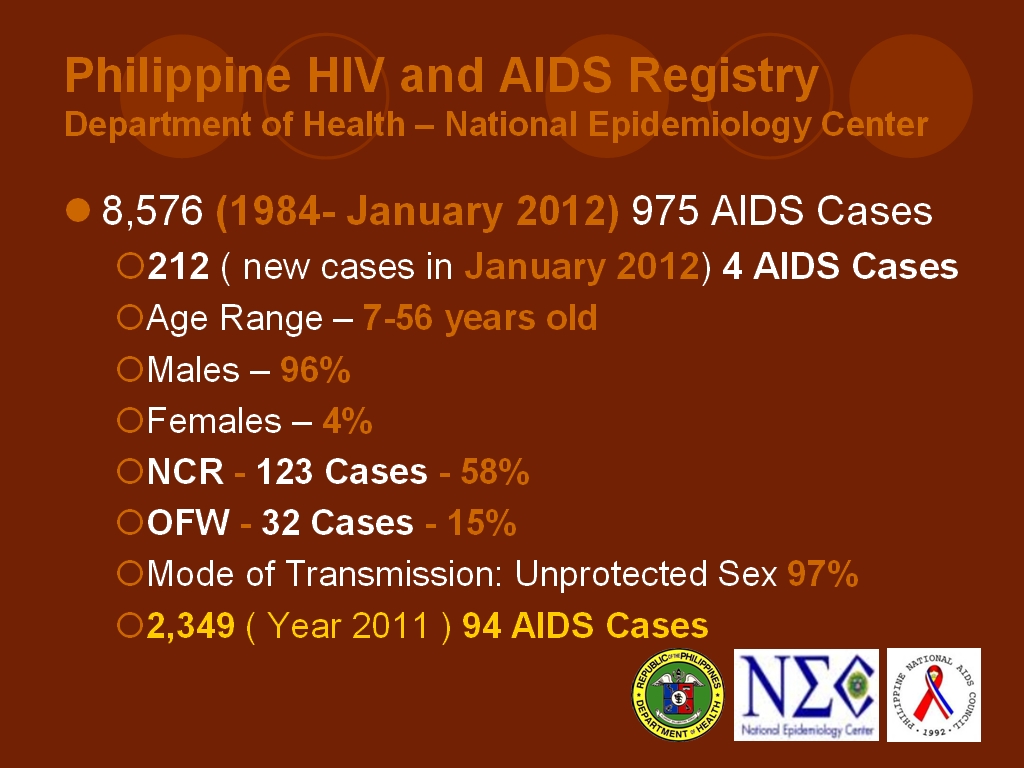
PHILIPPINE HIV and AIDS REGISTRY

The Philippine HIV & AIDS Registry is the official record of the total number of laboratory confirmed HIV positive individuals, AIDS cases and deaths, and HIV positive blood units in the Philippines. All individuals in the registry are confirmed by the STD/AIDS Cooperative Central Laboratory (SACCL) at San Lazaro Hospital. While all blood units are confirmed by the Research Institute for Tropical Medicine (RITM). Both are National Reference Laboratories (NRL) of the Department of Health (DOH).

Mandatory HIV testing is unlawful in the Philippines (RA 8504). The process of reporting to the Registry is as follows. All blood samples from accredited HIV testing facilities that are screened HIV reactive are sent to SACCL (individuals) or RITM (blood units) for confirmation. Confirmed HIV positive individuals and blood units are reported to the DOH-National Epidemiology center (NEC), and are recorded in the Registry.

The Registry is a passive surveillance system. Except for HIV confirmation by the NRL, all other data submitted to the Registry are secondary and cannot be verified. An example would be an individual's reported place of residence. the Registry is unable to determine if this reported address is where the person got infected, or where the person lived after being infected, or where the person is presently living, or whether the address is valid. This limitation has major implications to data interpretation. Thus, readers are cautioned to carefully weigh the data and consider other sources of information prior to arriving at conclusions.

PHILIPPINE HIV and AIDS REGISTRY 2013

JANUARY


FEBRUARY


MARCH 


-------------------------------------------------------------------------------
PHILIPPINE HIV and AIDS REGISTRY 2012

JANUARY


FEBRUARY


MARCH


APRIL


 MAY


JUNE


JULY


AUGUST


SEPTEMBER


OCTOBER


NOVEMBER


DECEMBER


PHILIPPINE HIV and AIDS REGISTRY 2013

THERE WILL BE UPDATES EVERY MONTH SO STAY TUNED
FOR FURTHER DETAILS PLEASE VISIT OR DOWNLOAD THE FILE. HERE'S THE SITE http://www.pnac.org.ph/index.php?page=philippine-hiv-and-aids-registry


Source:
Department of Health - National Epidemiology Center


JaKe Positive. BE SAFE! +)

FOR QUESTIONS & INQUIRIES:

Facebook: www.facebook.com/jakepositive
E-mail: jakepositive@gmail.com
Twitter:
@jake_positive
HELPLINE #'s: 09278230300 / 09323298893